How AI-Powered Facial Recognition Accelerates Efficiency?
Modern industries rely heavily on fast and accurate identity verification; here, an AI-powered facial recognition plays an important role. What’s that, we will discuss in this blog.
Traditional facial recognition often struggles with speed and reliability. Many organisations face delays during verification because their legacy systems rely on manual feature extraction and outdated image processing workflows.
These limitations create slow responses, operational inefficiencies, and higher security risks across airports, banks, workplaces, and public environments. Furthermore, traditional systems frequently generate false positives and false negatives due to lighting issues, pose variations, and low-resolution images.
These errors not only frustrate users but also compromise safety. As digital ecosystems evolve, businesses now require systems that confidently identify individuals within milliseconds.
Thankfully, artificial intelligence brings the speed, intelligence, and automation needed to transform facial recognition into a faster, more accurate, and more dependable solution for modern security challenges.

Why Organizations Need AI-powered Facial Recognition Today?
Businesses across various industries now rely on seamless identity verification, as daily operations necessitate stringent security and seamless user experiences. Additionally, modern environments like airports, banks, and corporate buildings handle thousands of users each day. On the other hand, manual verification becomes time-consuming and unsustainable.
Facial recognition provides a non-intrusive method that verifies identity without requiring physical interaction. Artificial intelligence in biometric authentication also enhances compliance and minimises the risk of unauthorised access.
Moreover, sectors like policing, transportation, and fintech increasingly adopt biometric authentication because it strengthens safety while reducing human errors. Therefore, organisations view facial recognition as an essential component of their digital transformation journey.
Where Traditional Facial Recognition Systems Fall Short?
Despite its popularity, traditional facial recognition systems often struggle in real-world environments. These critical challenges emerge because older systems depend on rule-based matching methods that rely heavily on mathematical models rather than adaptive learning.
Although these methods work under ideal conditions, they fail when lighting varies, angles shift, or users move quickly.
Moreover, legacy systems scan only limited features extracted manually, which slows down the entire process. They also require extensive preprocessing before running comparisons, which creates delays during peak operation periods.
Additionally, traditional systems cannot correct themselves or learn from errors, making them less reliable in changing environments. As a result, security teams often encounter higher error rates, longer verification times, and reduced operational accuracy.
Why Traditional Systems Produce False Positives & False Negatives?
Miss Identification
False positives happen when the system incorrectly identifies someone as another person. False negatives occur when the system fails to identify a valid individual. Both errors create significant risks.
Fixed Alogorithms
Traditional systems generate these errors because fixed algorithms cannot understand facial variations caused by age, angles, expressions, or lighting. Furthermore, older models depend on limited datasets, resulting in weak feature extraction and inaccurate comparison.
Consequently, the recognition pipeline often misinterprets crucial patterns, especially when images are low quality or partially obstructed. Here. An AI-powered facial recognition system approach can help.
Diverse Population
Additionally, rule-based systems cannot handle diverse populations effectively because they lack deep contextual learning. This limitation leads to biased results, making traditional technologies unreliable for large-scale deployment across varied demographics.
How AI Resolves Accuracy Problems in Facial Recognition?
Artificial intelligence addresses performance issues by analysing faces through deep learning models that recognise complex patterns with greater precision. These models examine every micro-detail, including textures, angles, contours, and light variations. Therefore, AI-based recognition remains stable even in uncontrolled environments.
Furthermore, AI reduces false positives and false negatives through continuous model training. As new data enters the system, the AI refines its understanding of faces, improving accuracy over time.
Additionally, machine learning evaluates previous recognition attempts, identifies recurring errors, and adapts the comparison logic accordingly. Consequently, AI delivers more reliable and consistent results than traditional systems.
How AI Fast-Tracks The Entire Facial Recognition Process?
Artificial intelligence accelerates recognition by transforming each stage of the workflow into an intelligent, automated pipeline. Deep learning eliminates the need for manual feature extraction and lengthy preprocessing, significantly cutting down overall processing time.
Let’s know the process in detail.
AI Enhances The Face Detection Stage
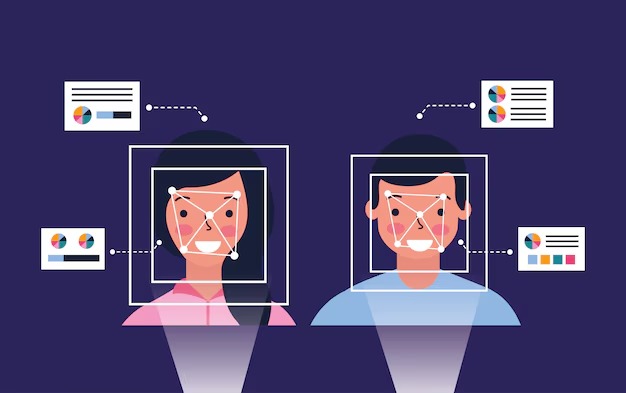
AI-powered models quickly detect faces within milliseconds using Convolutional Neural Networks. These networks scan frames and identify facial regions with impressive accuracy.
Artificial intelligence in biometric authentication generally focuses only on relevant pixels, which reduces unnecessary computation. As a result, detection becomes faster and more efficient, even in crowded or dynamic environments.
AI Improves Feature Extraction through Intelligent Mapping
Feature extraction becomes significantly faster through deep neural networks that automatically map patterns on the face. Instead of relying on predefined rules, AI reads facial structures naturally and converts them into highly detailed biometric signatures.
Moreover, AI maintains speed even when analysing multiple faces simultaneously, making it suitable for large-scale operations.
AI Maximises Speed during The Matching Phase
The matching process once required extensive database scanning, which slowed down verification.
However, AI uses optimised vector comparison algorithms that allow parallel matching across extremely large datasets. Consequently, identification becomes nearly instantaneous, even when the system evaluates millions of stored identities.
Deep Learning: The Core Engine behind Faster Recognition
Deep learning powers modern recognition models through layered architectures trained on millions of facial images.
These networks learn complex patterns impossible for traditional systems to detect. Furthermore, deep learning enhances recognition speed because it processes information simultaneously across many layers.
Additionally, GPU and TPU acceleration support high-speed processing, making deep learning ideal for real-time recognition tasks. Therefore, deep learning forms the backbone of fast, scalable AI-powered facial recognition.
Edge AI Eliminates Latency in Real-Time Facial Recognition
Older systems required facial data to reach cloud servers for processing. This caused delays whenever network performance dropped. However, Edge AI analyses data directly on devices like cameras, smartphones, and local servers.
Consequently, recognition happens faster because information does not travel long distances. Moreover, edge processing enhances user privacy because sensitive data remains on-site.
AI-Driven Liveness Detection Strengthens Security & Speed
Artificial intelligence also verifies that a real human stands before the camera. It detects micro-movements, depth variations, and texture changes that distinguish real faces from photos or deepfakes.
Additionally, liveness checks occur in milliseconds, ensuring seamless security without delaying user experiences.
AI Streamlines Multi-Frame Analysis for Moving Subjects
People rarely stand still during verification. Thankfully, AI analyses multiple frames quickly and identifies the best-quality frame automatically.
Consequently, systems achieve faster and more accurate recognition even when users move, talk, or turn their heads. This capability makes AI suitable for smart surveillance, access control, and public monitoring.
AI-Based Compression Enhances Transmission & Processing Speed
Facial images often carry large file sizes. However, AI compresses these images while retaining important biometric details.
Hence, this compression speeds database comparisons and shortens storage operations. Furthermore, lightweight facial signatures allow faster recognition during peak usage.
Future AI Innovations Driving Even Faster Recognition
Emerging technologies will further accelerate recognition pipelines.
- Quantum computing models may process facial vectors instantly.
- Additionally, autonomous AI pipelines will adjust recognition rules without manual intervention.
- Moreover, emotion-aware recognition may support context-driven identification, enhancing system responsiveness.
End Note
Artificial intelligence elevates facial recognition to a level where speed and accuracy coexist effortlessly. It eliminates the slow, rigid workflows of traditional systems and replaces them with intelligent, self-learning processes. Moreover, AI-powered facial recognition systems reduce errors, enhance reliability, and support large-scale operations with impressive consistency.
As industries demand faster and more secure identity verification, AI-based facial recognition emerges as the most dependable and future-ready solution. Consequently, organisations adopting AI-driven systems gain stronger security, smoother user experiences, and remarkable operational efficiency.
Follow Dupli Scanner to read more such insightful blogs for knowledge gain.