Perfectly Use Conditional Sentences in English to Elevate Writing
Many writers struggle to express possibilities, consequences, or imagined outcomes in clear, professional English. Your ideas around conditional sentences in English often feel scattered, incomplete, or confusing to readers. As a result, even strong vocabulary cannot save weak sentence logic.
Conditional sentences play a silent yet powerful role in shaping meaning, accuracy, and flow. Without mastery of these structures, writing feels uncertain or poorly reasoned. Readers quickly sense this lack of control.
In professional, academic, or creative writing, clarity determines trust. Conditional sentences help writers explain cause-and-effect relationships with precision. So, when used correctly, they transform scattered thoughts into structured communication.
This mastery marks the difference between basic writing and polished, high-quality content that sounds confident, readable, and intentional. So, continue reading this blog by Dupli Scanner.

What Are Conditional Sentences in English Writing And Why Do They Exist?
Conditional sentences describe situations that depend on specific conditions, actions, or imagined circumstances. They explain what happens when something occurs or fails to occur.
These sentences help writers clarify relationships between actions and results. Without them, ideas feel disconnected or overly absolute. Conditional structures provide balance, logic, and flexibility in communication.
They allow writers to avoid exaggeration while remaining clear. In natural writing, conditionals help ideas unfold logically. Readers can follow reasoning without confusion or mental effort.
This is why conditional sentences form a core foundation of effective and quality writing through grammar precision.
Why Conditional Sentences Are Essential for Writing Quality?
- Quality writing is not just expressive; it is precise and responsible. Conditional sentences allow writers to present possibilities without making false guarantees.
- They help explain outcomes without sounding rigid or uncertain. This balance builds professional authority. Readers trust writing that acknowledges conditions and limitations.
- In business, education, and content writing, such clarity improves credibility. Conditional sentences guide readers through logic instead of forcing conclusions.
- As a result, writing becomes structured, thoughtful, and highly readable. Strong conditionals improve tone, flow, and interpretive accuracy simultaneously.
The Four Core Types of Conditional Sentences
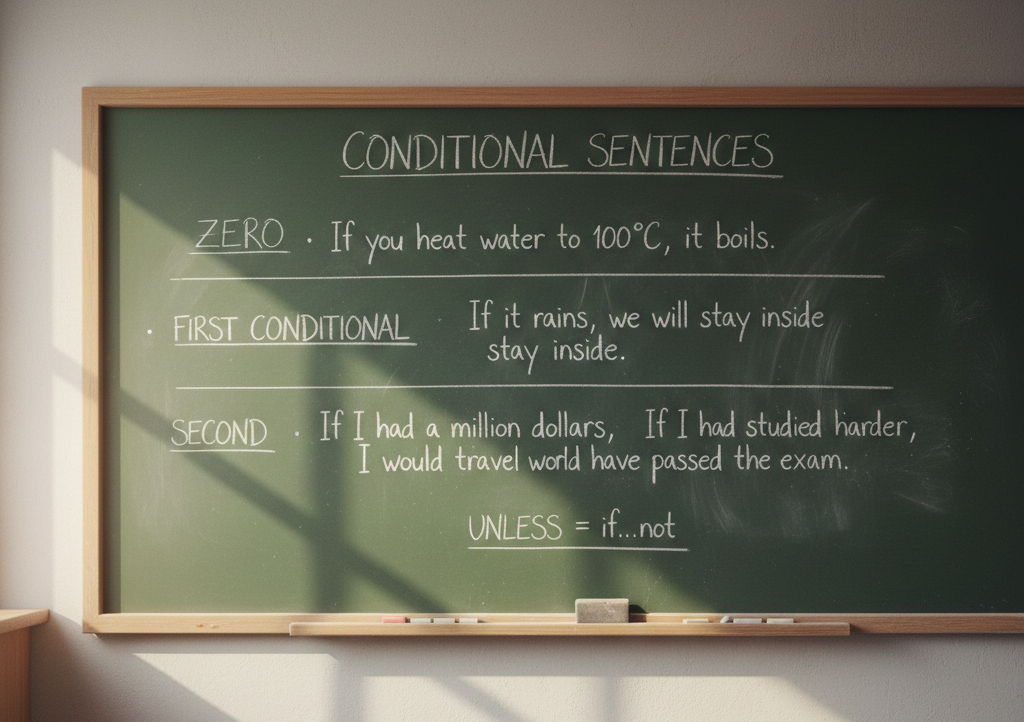
Conditional sentences follow four main patterns, each serving a specific communicative purpose. Understanding these types helps writers choose the correct tenses and structures naturally.
Zero Conditional: Stating Facts & Universal Truths Clearly
Zero conditional sentences express scientific facts, habits, and established truths. These sentences use the present tense in both clauses.
This structure signals certainty and consistency. Writers use zero conditionals in instructions, explanations, and educational content.
For example, predictable outcomes benefit from this structure. Zero conditionals remove ambiguity and strengthen authority. They reassure readers that the information presented is reliable.
In professional writing, this clarity enhances confidence and comprehension.
First Conditional: Discussing Realistic Future Outcomes
First conditional sentences in English focus on events that are likely or realistically possible. They connect present conditions with future results.
This structure works well in planning, forecasting, and decision-based writing. Writers often use first conditionals to explain consequences responsibly. This approach avoids overpromising. It also keeps communication grounded in reality.
Readers appreciate writing that respects logic and probability. As a result, first conditionals improve trust and readability.
Second Conditional: Exploring Hypothetical Present Or Future Situations
Second conditional sentences describe imagined or unlikely scenarios. They allow writers to express opinions, suggestions, or creative alternatives.
This structure helps explore ideas without asserting them as facts. Writers frequently rely on second conditionals for persuasive content. These sentences invite readers to think rather than accept conclusions blindly. This approach feels thoughtful and human.
It also adds emotional nuance without reducing professionalism. Second conditionals support balanced argumentation gracefully.

Third Conditional: Reflecting on Past Situations
Third conditional sentences focus on hypothetical past events and their imagined results. These structures help analyse missed opportunities or alternative outcomes.
Writers often use them in evaluations, lessons learned, or reflective writing. This conditional form adds depth and maturity to content. It shows awareness and accountability.
Readers connect with writing that acknowledges complexity rather than perfection. Third conditionals for quality writing through grammar precision help writers sound experienced, reflective, and insightful.
How Conditional Sentences Improve Flow & Logical Progression?
Readers prefer writing that moves smoothly from idea to idea. Conditional sentences help create this flow naturally. They guide readers through assumptions, decisions, and consequences logically. Instead of abrupt statements, writing feels connected.
Transitional phrases combine well with conditionals, enhancing coherence. Paragraphs feel unified rather than fragmented. This logical rhythm keeps readers engaged longer. Writing with strong flow feels effortless to read and easier to remember.
Precision Through Conditional Sentences: Why It Matters?
Precision defines professional writing standards. Conditional sentences allow writers to clearly define limits and possibilities.
They prevent misleading statements. Writers avoid sounding overly confident or vague. This balance shows responsibility and expertise. Precision strengthens argument quality and reader trust. When writing feels accurate, readers respect the message.
Conditional sentences deliver that accuracy consistently across various writing forms.
Common Mistakes Writers Make with Conditional Sentences
Many writers incorrectly mix verb tenses within conditional structures. Others use unreal conditions to describe factual situations. These errors confuse readers.
Sometimes, punctuation disrupts clarity. These mistakes often happen when writers rely on intuition instead of understanding.
Unfortunately, such errors weaken the entire piece. Awareness is the first step to improvement. Careful revision of conditional sentences in English helps eliminate these issues effectively.
How to Improve Conditional Sentence Usage Naturally?
- The first step involves identifying the situation type clearly. Writers should ask whether the idea is factual, possible, hypothetical, or reflective.
- Next, selecting the correct conditional structure becomes easier. Reading aloud helps detect awkward logic.
- Focused editing improves accuracy over time. Consistent practice builds confidence. Improvement comes from mindful repetition, not memorisation.
Why Perfection in Conditional Use Changes Writing Quality?
Perfection in writing does not mean complexity. It means control. Conditional sentences help writers align meaning with structure accurately.
When structure supports intention, writing becomes powerful. Readers understand the message without effort. Engagement increases naturally. Trust follows clarity.
This is how grammatical precision elevates overall communication quality.
Conditional Sentences across Writing Domains
Different writing fields depend on conditional sentences differently. Academic writing uses them for hypotheses and critical discussions. Business writing relies on them for policies and projections.
Creative writing explores emotional alternatives through conditionals. Content writing uses them to guide readers responsibly. Across all domains, conditionals remain essential.
They adapt without losing relevance.
Practice: The Final Ingredient for Mastery
Regular practice strengthens conditional sentence fluency. Rewriting statements into different conditional forms builds flexibility. Studying professional writing sharpens recognition patterns. Over time, correct usage becomes intuitive. Practice transforms theory into habit. This is where real improvement begins.
End Note
Conditional sentences in English quietly structure strong English writing. They shape cause, consequence, and possibility with clarity. Writers who master them sound confident and human.
Their content feels polished without losing warmth. Precision replaces uncertainty. Ultimately, perfection in conditional usage delivers writing quality that readers trust, respect, and enjoy consistently.If you want to read more such interesting blogs, explore the blogs at Dupli Scanner.