A few years ago, asking artificial intelligence to write an email or answer a question felt revolutionary. Today, AI can do much more than generate text. It can plan tasks, make decisions, interact with software, and even complete multi-step workflows with minimal human involvement.
This new generation of intelligent systems is powered by AI agents, a technology that is rapidly changing how businesses and individuals work.
If terms like AI agents, autonomous assistants, or intelligent workflows seem confusing, you’re not alone. Many people have heard the buzz but are still trying to understand what these systems actually do and why they matter.
At Dupli Scanner, helping people understand emerging AI technologies is just as important as exploring their capabilities. This beginner-friendly guide explains AI agents in simple language, how they work, where they are used, and why they could become one of the most influential technologies of this decade.
What Are AI Agents?
Think of an AI chatbot as someone who answers questions.
Now imagine someone who not only answers questions but also plans the work, completes it, checks the results, and automatically improves the process.
That is the simplest way to understand AI agents.
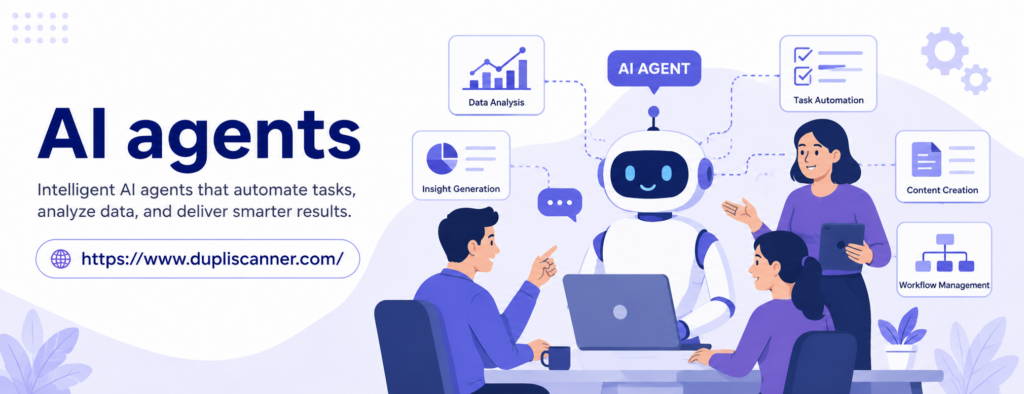
An AI agent is an intelligent software system capable of observing information, making decisions, taking actions, and working toward a specific goal with limited human intervention. Instead of waiting for instructions at every step, AI agents can determine their next action themselves.
For example, instead of asking AI to:
- Write an email
- Find customer information
- Schedule a meeting
…an AI agent can perform all three tasks automatically after receiving one instruction. That ability separates modern AI agents from traditional AI tools.
Why Are AI Agents Becoming So Popular?
Artificial intelligence has evolved rapidly over the past few years. Initially, AI focused mainly on answering questions or generating content. Now businesses want something different.
They want AI that can actually work.
Instead of assisting employees with individual tasks, organisations want systems capable of completing entire workflows. This demand has accelerated interest in AI automation, allowing companies to save time while improving operational efficiency.
How Do AI Agents Actually Work?
Although AI agents seem incredibly intelligent, their workflow follows a structured process.
Step 1: Understand The Goal
Everything begins with an objective.
For example:
“Research the top competitors and prepare a summary.”
The agent identifies the desired outcome before taking action.
Step 2: Gather Information
Next, it collects relevant information. Depending on its capabilities, the agent may:
- Search databases
- Analyze documents
- Retrieve company data
- Access connected software
This information forms the basis for decision-making.
Step 3: Plan The Process
Rather than immediately producing an answer, AI agents often create an internal plan.
They decide:
- Which task comes first
- Which tools are needed
- What information is missing
- How to reach the final objective
This planning ability makes them significantly more capable than standard chatbots.
Step 4: Execute Tasks
The agent begins performing each task.
For example, it may:
- Draft reports
- Send emails
- Generate spreadsheets
- Organize files
- Schedule appointments
Some advanced systems even coordinate multiple applications simultaneously.
Step 5: Review and Improve
Many modern AI agents evaluate their own work before presenting the final result. If errors are detected, they attempt corrections automatically. This iterative process increases overall quality.
AI Agents Vs Traditional AI Tools
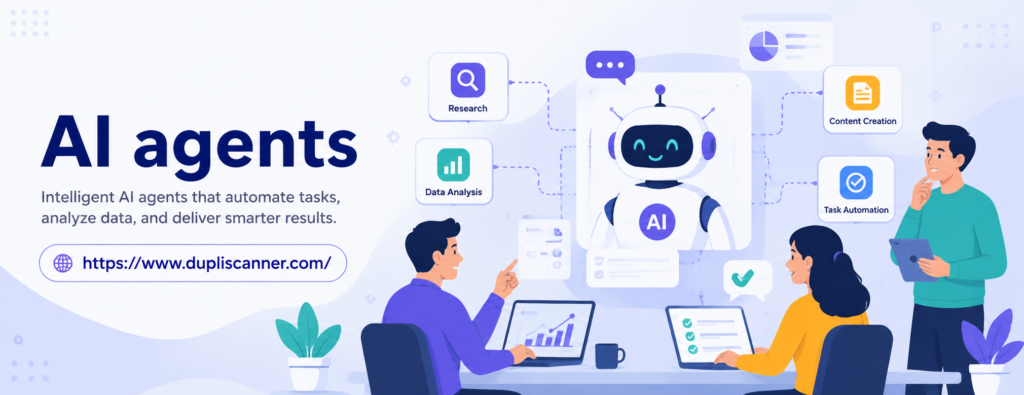
Many beginners confuse AI agents with tools like chatbots. Although they share similarities, important differences exist.
| Traditional AI | AI Agent |
| Answers questions | Completes objectives |
| Waits for instructions | Plans multiple actions |
| Single interaction | Multi-step workflow |
| Limited memory | Uses context across tasks |
| Mostly reactive | More proactive |
The key distinction lies in independence.
Traditional AI responds, and AI agents act.
Real-World Examples of AI Agents
The easiest way to understand AI agents is through practical examples.
Customer Support
Instead of simply answering questions, an AI agent can:
- Verify customer identity
- Check order status
- Process refunds
- Escalate issues when necessary
Everything happens within one workflow.
Marketing Teams
An AI agent might:
- Research keywords
- Analyze competitors
- Draft blog outlines
- Schedule social media posts
This dramatically reduces manual effort.
Human Resources
Recruitment teams increasingly explore AI agents for:
- Resume screening
- Interview scheduling
- Candidate communication
- Report generation
Routine administrative work becomes significantly faster.
Personal Productivity
Individuals also benefit. How?
Imagine telling your AI: “Plan my business trip.”
An advanced agent could:
- Compare flights
- Reserve hotels
- Organise your calendar
- Prepare travel documents
All without constant supervision.
Are AI Agents Really Independent?
Not entirely.
Despite impressive capabilities, AI agents still rely on human guidance. They operate within defined goals, available tools, and established rules. So, it means they are not “thinking” independently like humans.
Instead, they make decisions based on data, probability, and programmed objectives. Therefore, understanding this distinction helps avoid unrealistic expectations.
What Are The Benefits of AI Agents?
Businesses increasingly invest in AI agents because they offer several practical advantages.
- Increased Productivity: Routine work becomes faster, allowing employees to focus on strategic decisions.
- Better Decision Support: Agents analyse large volumes of information much faster than humans. This helps organisations identify useful insights quickly.
- Consistent Performance: Unlike people, AI does not become tired during repetitive tasks. This consistency improves workflow reliability.
- Scalable Operations: As businesses grow, AI agents can often handle larger workloads without proportional increases in staffing. This makes AI automation highly attractive for expanding organisations.
What Are The Limitations of AI Agents?
AI agents are powerful, but they are not perfect. Understanding limitations is equally important.
- Hallucinations
Like other AI systems, agents may generate incorrect information if data is incomplete. Human verification remains essential.
- Limited Judgment
AI lacks emotional intelligence and real-world intuition. Complex ethical decisions still require people.
- Data Quality Matters
Poor input leads to poor output. If connected systems contain inaccurate information, the agent’s decisions may also suffer.
- Security & Privacy
Organisations must carefully manage permissions. An AI agent accessing sensitive systems requires strong security controls.
Will AI Agents Replace Human Jobs?
This question appears in almost every AI discussion. The more accurate answer is:
They will change jobs more than replace them.
Routine administrative work may become automated. However, creativity, leadership, empathy, negotiation, and strategic thinking remain deeply human strengths. Most experts believe future workplaces will combine human expertise with autonomous AI systems, allowing people to focus on higher-value work.
The goal is collaboration rather than replacement.
How Can Beginners Start Learning AI Agents?
Learning AI agents does not require becoming a software engineer.
A practical approach includes:
- Understanding basic AI concepts
- Exploring popular AI platforms
- Learning prompt engineering
- Studying workflow automation
- Experimenting with beginner-friendly tools
The technology evolves quickly, making continuous learning valuable.
At Dupli Scanner, simplifying emerging AI topics helps users build confidence while navigating this rapidly changing landscape.
The Future of AI Agents
Many technology experts believe AI agents will become as common as search engines or smartphones. Businesses may soon rely on multiple specialised agents working together.
One agent could manage customer service. Another could analyse business data. A third might coordinate marketing campaigns.
Rather than replacing software, AI agents will increasingly become intelligent layers connecting existing tools into seamless workflows. This evolution represents one of the most significant developments in artificial intelligence today.
Final Thoughts
The rise of AI agents marks an important shift in how people interact with technology. Instead of simply answering questions, these intelligent systems can plan, execute, and refine complex tasks with minimal human input.
While they are not flawless, their ability to automate workflows, improve productivity, and support better decision-making makes them one of the most exciting innovations in artificial intelligence.
As organisations and individuals continue exploring smarter ways to work, understanding AI agents becomes increasingly valuable. With trusted educational resources like Dupli Scanner helping decode emerging technologies, beginners can confidently move from curiosity to practical understanding and prepare for the future of intelligent automation.